Activities
Wooden Puzzles
Building little minds one piece at a time — shape recognition, problem solving and persistence in every puzzle.
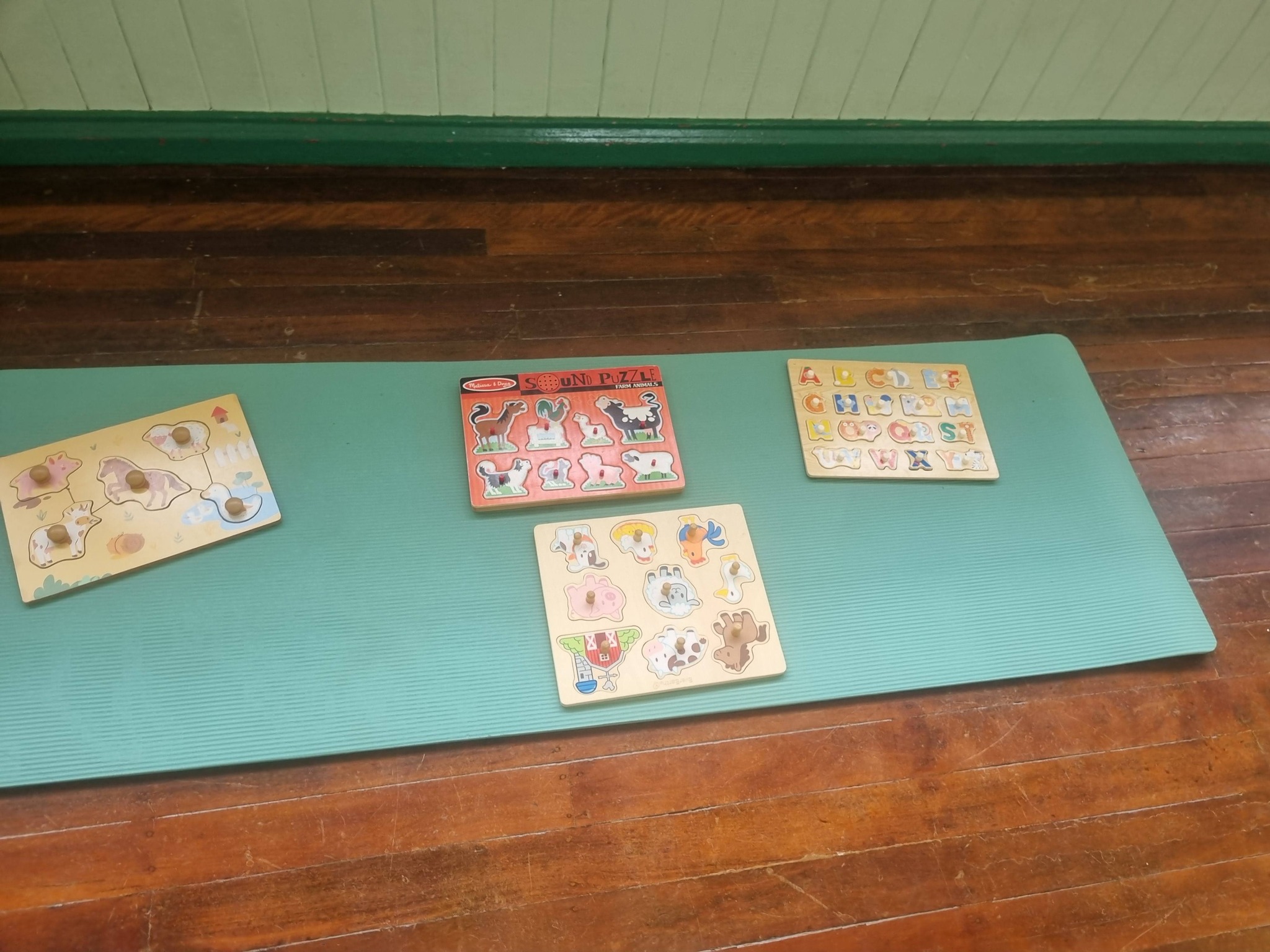
Building little minds one piece at a time — shape recognition, problem solving and persistence in every puzzle.
Our puzzle collection features a wide range of wooden peg puzzles — animals, vehicles, food, alphabet letters, numbers, and everyday objects. Peg puzzles are specifically designed for little hands: the chunky wooden pegs are easy to grip, and the bright illustrated backgrounds give children a picture clue to work with as they fit each piece into place.
We rotate our puzzle selection regularly so there's always something new to discover, and we have puzzles ranging from simple 4-piece boards right through to more complex 20-piece challenges for older children.
Puzzles might look like simple toys, but the cognitive work happening when a child works through one is remarkable. Shape matching, spatial reasoning, trial and error, persistence, and fine motor control are all active at the same time. Here's a closer look:
Gripping pegs, rotating pieces and placing them precisely builds the hand strength and control children need for drawing and writing.
Matching pieces by shape, colour and size builds early maths and literacy foundations well before formal schooling begins.
Working out which piece goes where — and figuring out why one doesn't fit — is genuine critical thinking practice for young minds.
Puzzles naturally present challenge. Learning to try again when a piece doesn't fit is an early lesson in managing frustration and building grit.
Completing a puzzle requires sustained attention — a skill that transfers directly into classroom learning and reading.
Animal puzzles, vehicle boards and alphabet sets naturally introduce new words, categories and concepts through hands-on play.
Puzzle time is a wonderful opportunity for caregivers to play alongside children without taking over. Rather than pointing to where a piece goes, try narrating what you notice: "That piece has a curved edge — where else can we see a curve?" This kind of open-ended talk builds language and reasoning far more powerfully than simply solving the puzzle for them.
If a child is frustrated, you can model putting a piece down and trying a different one — demonstrating that getting stuck is a normal, manageable part of the process.
Wooden peg puzzles are ideal from around 12 months, when children have enough pincer grip to grasp and lift the pegs. By 18 months, most toddlers can successfully complete simple 4–6 piece boards with occasional guidance. By age 3, many children can tackle 12–20 piece boards independently and begin to understand the strategy of sorting edge pieces or grouping by colour first.
We always have a selection available to suit every age and stage at our sessions.
If your child loves puzzles at our sessions, consider adding a few wooden peg puzzles to your home toy rotation. Look for puzzles with clear, realistic illustrations rather than abstract shapes — children find them easier to relate to. Store pieces in a flat tray or zip-lock bag so nothing gets lost, and rotate puzzles in and out every few weeks to keep the challenge fresh.
Explore more of what we offer at Perfect Squiggle.
Playgroup runs every Monday, 9:30am–11:30am at Bald Hills Uniting Church. $10 per family.
Book a Spot